
Sports prediction markets have emerged as a fascinating alternative to traditional sportsbooks, offering fans and traders a unique way to interact with games, players, and championship outcomes. Unlike sportsbooks, which are built primarily around odds for individual games or series, prediction markets allow participants to speculate on longer-term outcomes and aggregate collective expectations in real time. For example, a market tracking the likely winner of the Super Bowl can give insights not only on who is favored to win, but also on the probabilities the community assigns to every team in the league.
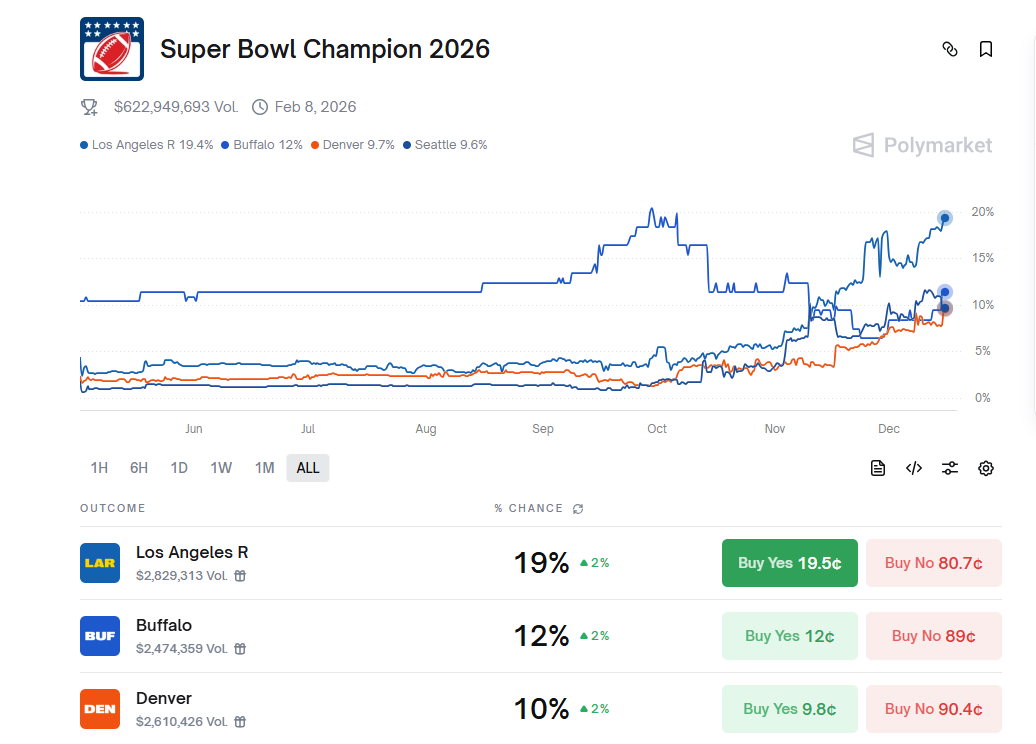
Take the current Super Bowl winner prediction market as an example. Teams like Los Angeles R lead with 20% probability, followed by Buffalo at 12%, Denver and Seattle each at 10%, and Philadelphia at 9%. Even teams with very low chances, like Indianapolis, Arizona, or Dallas, register less than 1% probability. Each outcome price reflects the collective judgment of participants who have evaluated team performance, injuries, coaching, schedule, and other factors. As more information comes in—like trades, injuries, or changes in team form—the market updates continuously, providing a dynamic picture of the league’s most likely champion.
One unusual aspect of sports prediction markets is their ability to show probabilities for every team simultaneously, rather than forcing bettors to focus on only a few favorites. In traditional sportsbooks, odds are presented in moneyline, point spread, or over/under formats, often encouraging betting only on teams with significant public interest. Prediction markets, by contrast, offer a more granular view. You can see not just the favorite, but also the marginal chances of mid-tier and underdog teams. This creates a richer data environment for both casual fans and serious analysts who want to measure implied probabilities rather than simply chasing the payout structure of a sportsbook.
Another difference is the transparency of probabilities. When Los Angeles R is priced at 20% and Buffalo at 12%, those numbers are not merely odds set by a bookmaker factoring in margin and public sentiment—they reflect real-money trades placed by participants who believe in the likelihood of a particular outcome. This means the market can sometimes react faster to new information than a sportsbook, which may adjust odds more slowly to maintain profitability or hedge risk. In essence, a prediction market converts knowledge, opinion, and research into a continuously updated probability signal.
The question then arises: is it unusual to bet on a platform like Polymarket instead of your traditional sportsbook? In some ways, yes—but not necessarily for the reasons you might expect. While traditional sportsbooks have existed for decades and are deeply integrated into the sports betting ecosystem, prediction markets offer features that sportsbooks cannot easily replicate. They are particularly appealing to those who enjoy thinking probabilistically, who want to see a full distribution of outcomes rather than a single line, and who are comfortable trading smaller positions on speculative outcomes. Additionally, prediction markets often operate in a more global and digital-native environment, making them attractive to tech-savvy participants who value speed, transparency, and community-driven odds.
Another reason some bettors might prefer prediction markets is educational or analytical value. By observing how the market prices different teams, a participant can gain insights into collective sentiment that may not be obvious from media coverage or conventional odds. For instance, if a market prices Philadelphia at 9% despite recent wins, it could signal that traders are concerned about injuries, schedule difficulty, or underlying team statistics. Traditional sportsbooks do not provide this level of granularity or explicit probability information—they focus instead on payout ratios and risk management.
However, there are reasons why bettors might stick with traditional sportsbooks. Sportsbooks are regulated, insured, and familiar. Winnings are easy to claim, and there are established legal frameworks governing play. Prediction markets, while increasingly legitimate, often exist in a more experimental regulatory space and may have restrictions based on jurisdiction. Liquidity can also vary; small markets may offer few counterparties, which can make trades more volatile or difficult to execute.
It’s also worth noting the psychological difference between the two. Sportsbooks incentivize betting for profit via odds and payout multipliers, whereas prediction markets incentivize accurate forecasting. You are rewarded in prediction markets not just for picking the “winner,” but for placing bets that reflect reality and outperform other participants. This makes them more like a forecasting tool than a traditional gambling environment, which can appeal to those who enjoy strategy, analysis, and probability over simply winning money on a favorite.
In summary, sports prediction markets offer a different way to engage with your favorite leagues and tournaments. They allow participants to see probabilities across the entire league, update continuously with new information, and reward careful analysis of team strength, injuries, and schedule dynamics. Betting on a prediction market like Polymarket instead of a traditional sportsbook is unusual in the sense that most casual bettors are accustomed to moneylines and spreads, but it is increasingly common among analysts, professional traders, and data-driven sports fans. The trade-off is between familiarity, regulation, and liquidity versus transparency, probabilistic reasoning, and a deeper understanding of collective expectations.
For fans willing to explore beyond conventional sportsbooks, prediction markets provide a window into how the crowd evaluates each team’s chances. Whether you are tracking Los Angeles R at 20% probability or observing long-shot teams under 1%, these markets give a nuanced, constantly updated, and engaging perspective on the race to the championship that traditional betting cannot fully replicate.