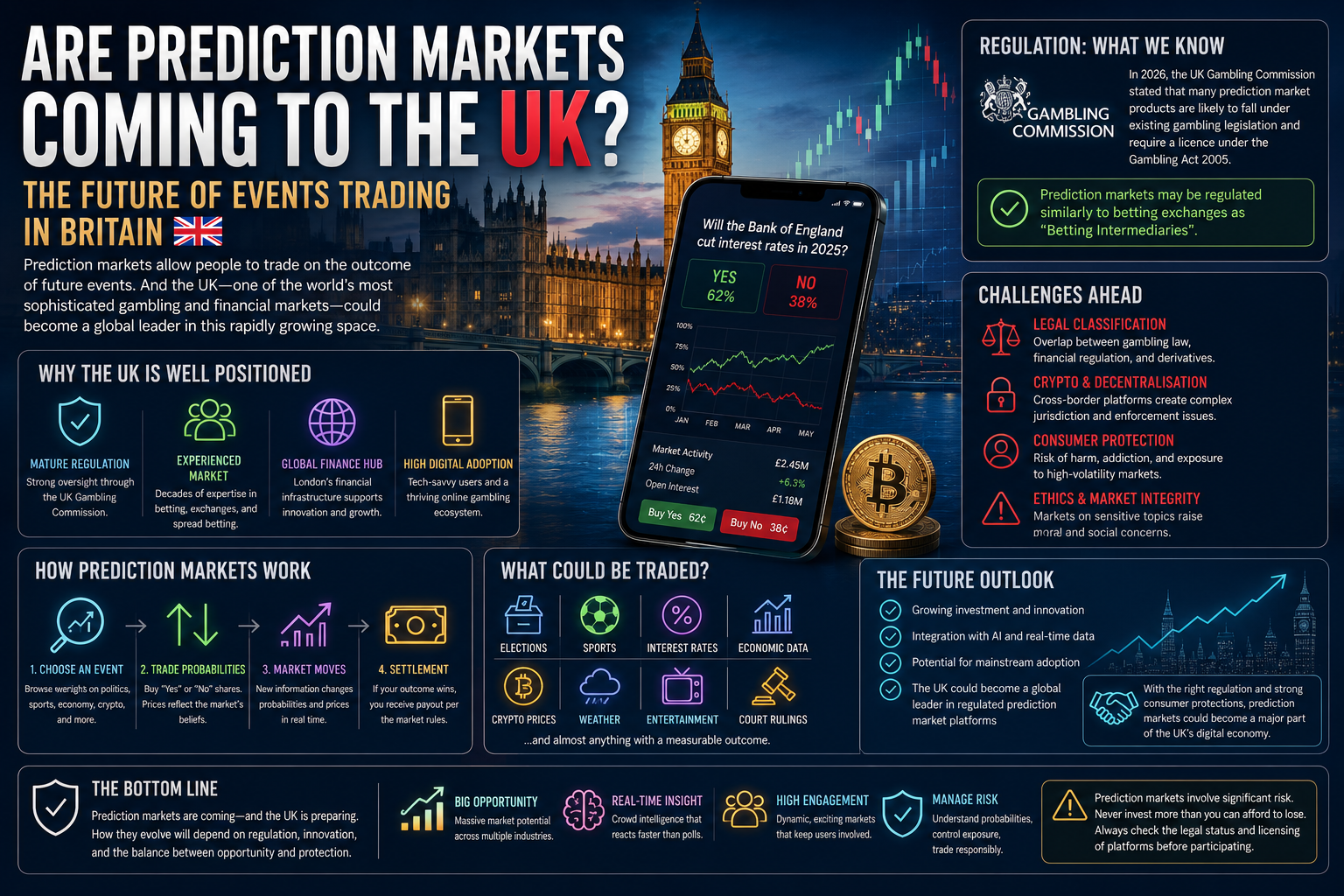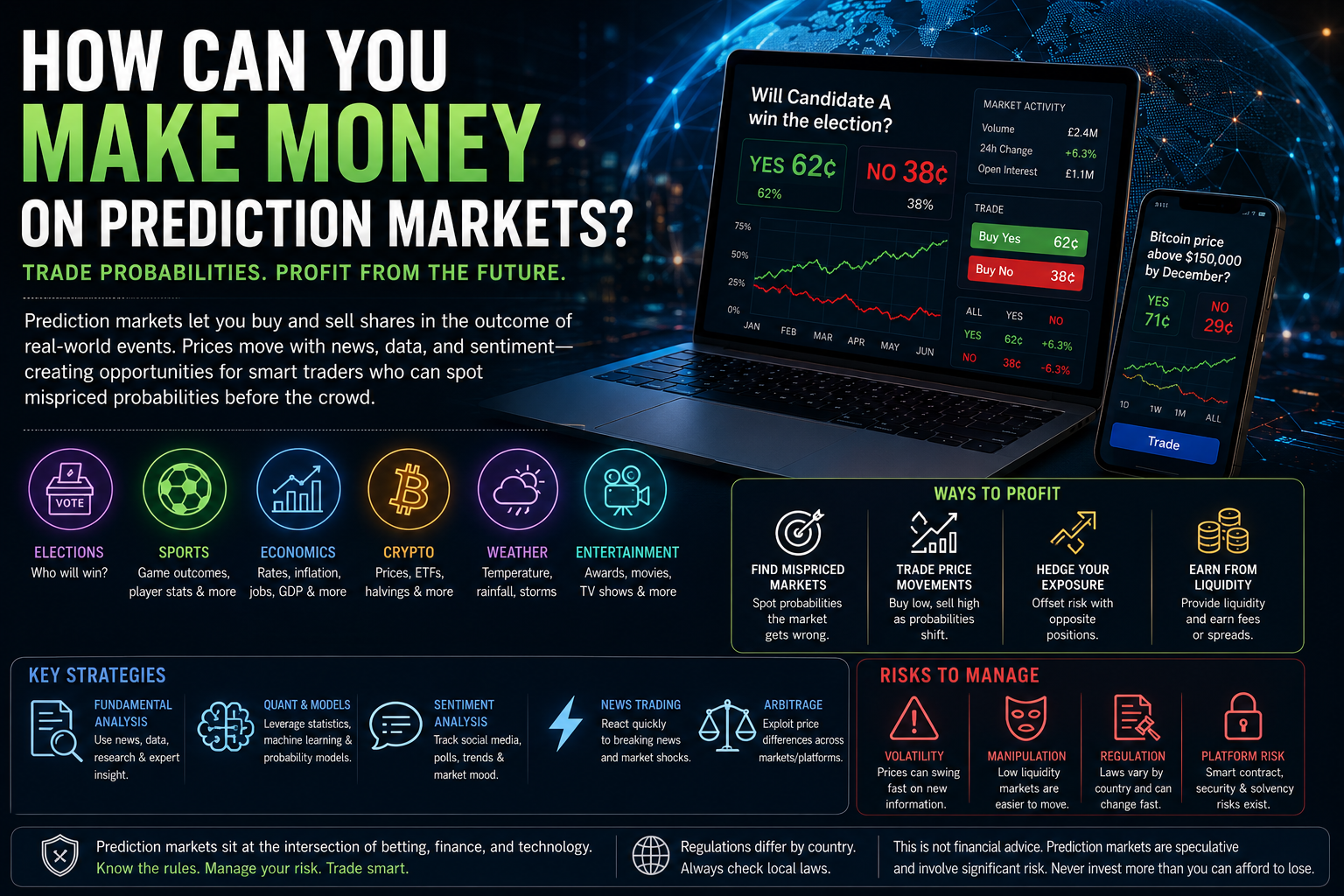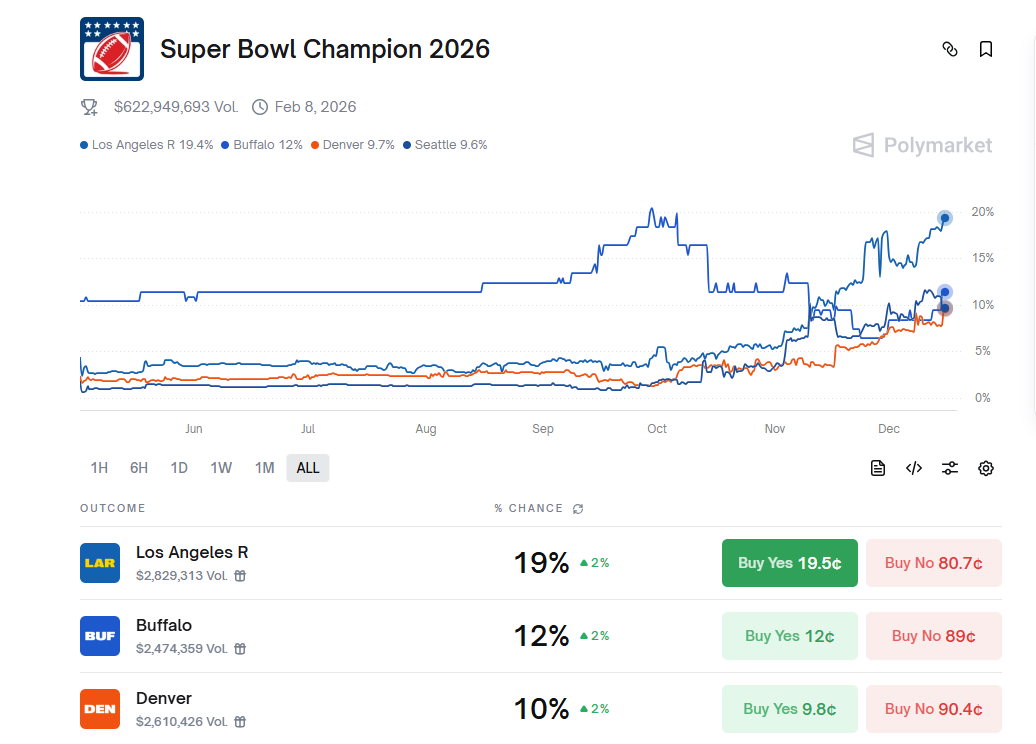
Prediction markets sit in one of the most fascinating and controversial areas of modern digital finance, gambling, and speculative technology. They combine elements of betting, financial trading, statistical forecasting, crowd intelligence, derivatives-style speculation, and event probability modelling into a single product category that increasingly attracts attention from regulators, investors, traders, political analysts, crypto communities, and gambling authorities around the world.
In simple terms, prediction markets allow users to speculate on the outcome of future real-world events. These events can include elections, sporting results, economic indicators, weather outcomes, entertainment awards, cryptocurrency prices, company launches, court decisions, geopolitical developments, and virtually any measurable future occurrence capable of producing a definitive result.
A user might buy shares in “Candidate A will win the election,” “Bitcoin will exceed $150,000 by December,” or “Interest rates will fall before Q4.” If the prediction becomes correct, the contract settles profitably. If incorrect, the trader loses their stake or position value.
At first glance, prediction markets can appear extremely similar to traditional sports betting or fixed-odds gambling. In other areas, they resemble financial derivatives or binary options trading. That overlap is exactly why the legal position surrounding prediction markets in the United Kingdom remains complicated, highly nuanced, and heavily dependent on how a particular platform operates.
The short answer is that prediction markets can potentially be legal in the UK under certain structures and regulatory models, but many forms of prediction market activity may also fall under gambling regulation, financial services regulation, or potentially both simultaneously depending on how the platform is designed, marketed, settled, and monetised.
That complexity is one reason prediction markets continue attracting enormous regulatory attention globally.
The UK has one of the world’s most developed gambling regulatory systems through the UK Gambling Commission, alongside one of the world’s largest financial regulatory systems through the Financial Conduct Authority. Any platform operating in the space potentially enters territory monitored by both gambling law and financial law simultaneously.
Historically, the UK has generally taken a more permissive and innovation-friendly approach toward betting markets than many jurisdictions. Political betting, novelty betting, and event-based wagering have existed legally through licensed bookmakers for decades. British consumers can legally place bets on elections, television outcomes, award ceremonies, royal events, economic indicators, and other non-sporting occurrences through regulated betting operators.
That historical acceptance creates an important distinction when comparing the UK to countries like the United States, where prediction market legality has often faced much more aggressive restrictions and federal scrutiny.
However, simply because political or event betting exists legally in the UK does not automatically mean every prediction market platform operates legally.
The regulatory classification matters enormously.
If a platform is effectively functioning as a bookmaker offering odds on future events, it may require full gambling licensing under the Gambling Act 2005. If the platform instead resembles a financial exchange, derivatives venue, or speculative trading marketplace, it may fall under financial regulation instead.
This is where the sector becomes especially interesting.
Modern prediction markets increasingly market themselves not as gambling products, but as “information markets,” “forecast exchanges,” “probability trading systems,” or “decentralised event markets.” Supporters argue these platforms generate valuable crowd-sourced forecasting intelligence with real economic and social utility rather than merely facilitating gambling.
Advocates often point toward the ability of prediction markets to aggregate distributed knowledge more efficiently than polls, commentators, or traditional forecasting models. Some economists and technologists even argue that prediction markets can improve policy forecasting, election analysis, market expectations, and corporate planning.
Critics, however, frequently argue that many prediction markets simply represent rebranded gambling products attempting to avoid stricter betting regulation.
That tension sits at the heart of the legal debate.
The legal status of a prediction market in the UK often depends on factors such as:
whether users stake money on uncertain future outcomes,
whether profit is generated from event resolution,
whether contracts are tradeable,
whether the platform acts as principal or intermediary,
whether odds or market pricing are involved,
whether the structure resembles derivatives trading,
whether cryptocurrencies are used,
whether leverage exists,
whether the market operates decentralised infrastructure,
and whether the activity falls within existing regulated investment definitions.
The emergence of blockchain technology and decentralised finance has complicated matters even further.
Crypto-based prediction markets such as Polymarket, Augur, and similar decentralised event trading systems have attempted to create borderless markets where users trade event outcomes using cryptocurrencies rather than traditional fiat betting structures.
These platforms often argue they are not traditional gambling operators because they function more like decentralised protocols or peer-to-peer information exchanges.
Regulators have not always agreed.
In many jurisdictions globally, authorities increasingly view prediction markets as potentially falling within gambling laws, securities laws, commodities regulation, or derivatives oversight depending on how contracts are structured.
In the UK specifically, crypto-related prediction markets introduce additional regulatory complexity because cryptoassets themselves remain subject to evolving oversight frameworks involving anti-money laundering obligations, financial promotions rules, consumer protection considerations, and financial crime monitoring.
Another major issue involves binary outcomes.
Many prediction markets effectively function similarly to binary options, where a contract either settles at full value or worthless depending on whether an event occurs. Binary options themselves became heavily restricted in multiple jurisdictions after widespread concerns over consumer harm, speculative abuse, and unregulated operators.
That history creates additional caution among regulators reviewing event-trading products.
One of the reasons prediction markets attract such intense debate is because they blur the traditional boundary between gambling and investing.
If somebody speculates on whether a football team wins, society generally labels that gambling.
If somebody speculates on whether inflation rises, interest rates fall, or an election changes fiscal policy, participants sometimes attempt to frame the activity as financial forecasting or information discovery instead.
Yet economically, the underlying behavioural mechanics can appear extremely similar.
This creates a philosophical as well as legal challenge.
Some legal analysts argue prediction markets should largely fall under gambling regulation because users are staking money on uncertain outcomes outside their direct control.
Others argue prediction markets potentially create genuine economic value through probabilistic forecasting and therefore should be treated differently from pure games of chance.
The UK regulatory system historically tends to focus less on philosophical arguments and more on operational realities.
Authorities generally examine what the platform actually does, how users interact with it, how money flows through the system, how outcomes are determined, and whether regulated activities are occurring under existing law.
That means there is unlikely to be one universal answer covering every prediction market platform equally.
Some may potentially operate legally under gambling licences.
Some may require financial regulatory permissions.
Some may fall into legally uncertain territory.
Some offshore platforms may technically accept UK users without being properly authorised domestically.
And some decentralised protocols may exist in areas where enforcement itself becomes practically difficult.
Consumer protection remains a major issue in this sector.
Prediction markets can become highly speculative, emotionally charged, politically controversial, and extremely volatile during major world events. Because pricing reflects perceived probabilities, users may rapidly buy and sell positions based on news cycles, rumours, polling changes, social media narratives, or breaking geopolitical developments.
This creates environments where misinformation, manipulation concerns, and herd psychology can significantly affect market behaviour.
Liquidity also matters enormously.
Smaller prediction markets may produce distorted probabilities because relatively little capital can move pricing aggressively. Thin liquidity can create misleading implied probabilities that appear more authoritative than they actually are.
At the same time, supporters argue prediction markets sometimes outperform traditional forecasting mechanisms precisely because participants risk real money rather than merely expressing opinions.
The commercial potential of the industry is substantial.
Prediction markets sit at the intersection of several enormous sectors simultaneously:
online gambling,
financial trading,
cryptocurrency,
data forecasting,
AI-driven analytics,
political media,
sports speculation,
and behavioural economics.
As AI systems increasingly consume real-time probability data and event forecasting signals, some technologists believe prediction markets may eventually become core informational infrastructure feeding future automated decision systems.
That possibility partly explains why major venture capital firms, crypto investors, fintech entrepreneurs, and technology commentators continue showing interest in the sector despite legal uncertainty.
The UK itself could potentially become an important market for prediction platforms because British consumers already possess relatively high familiarity with betting exchanges, spread betting, event wagering, financial speculation, and digital gambling products compared with many countries.
Platforms such as Betfair helped normalise exchange-based betting mechanics years ago, where users effectively trade positions against one another rather than simply betting against the bookmaker. That behavioural familiarity may make prediction markets feel more intuitive to UK consumers than elsewhere.
However, regulatory acceptance of traditional betting exchanges does not necessarily guarantee blanket approval for crypto-based event derivatives or decentralised prediction protocols.
The UK continues tightening scrutiny across online gambling, cryptocurrency marketing, consumer financial risk, and digital speculative products generally.
Any company considering launching a prediction market targeting UK users would likely require extremely careful legal analysis involving gambling law specialists, financial regulatory advisers, compliance experts, licensing professionals, AML frameworks, data governance considerations, and potentially cross-border legal structuring.
The reputational risk also matters.
Prediction markets involving assassination attempts, wars, pandemics, disasters, civil unrest, or human tragedy have generated major ethical criticism internationally. Some critics argue monetising catastrophic events creates dangerous incentives or morally questionable speculation environments.
Supporters counter that markets already exist indirectly around geopolitical instability through commodities, equities, insurance pricing, and macroeconomic trading.
Again, the debate becomes both legal and philosophical.
What seems increasingly clear is that prediction markets are unlikely to disappear.
Instead, the industry appears to be evolving toward a long-term collision between gambling regulation, financial regulation, crypto infrastructure, AI forecasting systems, and crowd intelligence economics.
The UK will almost certainly remain one of the most important jurisdictions to watch because of its deep expertise in both regulated betting markets and global financial services.
For consumers, the most important practical point is understanding that not every prediction market platform accepting UK users necessarily operates with full UK regulatory approval. Users should carefully examine licensing status, regulatory protections, dispute resolution frameworks, fund security, KYC requirements, responsible gambling controls, and financial risk disclosures before participating.
Prediction markets may look simple on the surface, but legally they sit within one of the most complicated intersections of gambling, finance, technology, and digital regulation currently emerging in the global online economy.
Frequently Asked Questions About Prediction Markets in the UK
1. What exactly is a prediction market?
A prediction market is a platform where people speculate on the outcome of future events using money, tokens, contracts, or tradeable positions. Users effectively buy and sell probabilities relating to real-world events. These can include elections, sports, cryptocurrency prices, economic announcements, celebrity outcomes, entertainment awards, weather events, or geopolitical developments.
Most prediction markets work by assigning prices to possible outcomes. Those prices fluctuate depending on what participants believe is most likely to happen. If the prediction becomes correct, winning positions settle profitably. Incorrect predictions lose value or expire worthless.
Prediction markets are sometimes referred to as event markets, information markets, forecasting exchanges, or event trading platforms.
2. Are prediction markets fully legal in the UK?
The answer is complicated.
Certain forms of prediction-style betting are legal in the UK when operated by properly licensed gambling companies. However, some prediction market platforms may potentially fall under gambling regulation, financial regulation, crypto regulation, or combinations of all three depending on how the system operates.
There is no single universal legal classification covering every prediction market equally.
The legality often depends on:
the structure of the contracts,
how users trade,
whether money is staked,
whether cryptoassets are involved,
whether outcomes resemble betting or financial derivatives,
and whether the platform holds the appropriate licences or permissions.
3. Why is the legal position so complex?
Prediction markets sit between multiple industries simultaneously.
They combine elements of:
gambling,
financial trading,
speculation,
probability forecasting,
crowd intelligence,
cryptocurrency,
and derivatives markets.
Because of this overlap, regulators may interpret the same platform differently depending on how it operates.
One authority may see gambling.
Another may see financial trading.
Another may see unregulated speculative contracts.
That creates substantial legal grey areas.
4. Does the UK allow betting on political events?
Yes.
The UK has historically allowed betting on political events through licensed bookmakers. British consumers can legally place bets on elections, party leadership contests, referendums, and other political outcomes through regulated operators.
This differs from some jurisdictions where political betting is heavily restricted or prohibited.
However, traditional political betting through bookmakers is not necessarily identical to modern decentralised prediction markets.
5. Are prediction markets the same as gambling?
This is one of the biggest debates surrounding the industry.
Critics argue prediction markets are effectively gambling because users risk money on uncertain future outcomes.
Supporters argue prediction markets create useful forecasting intelligence and should be viewed more like information systems or financial forecasting tools.
Legally, regulators often focus less on philosophical arguments and more on operational reality.
If users risk money based on uncertain events and profit from correct outcomes, gambling regulation can potentially apply.
6. Are prediction markets considered financial products?
Sometimes they can be.
Certain prediction market structures resemble binary options, derivatives, or speculative financial contracts. If the product behaves more like a financial instrument than traditional betting, financial regulation may become relevant.
This is especially important when contracts are tradeable, tokenised, leveraged, or structured similarly to investment products.
7. What role does the UK Gambling Commission play?
The UK Gambling Commission regulates gambling activity in Great Britain.
If a prediction market is classified as gambling under UK law, operators may require proper licensing and compliance with strict rules involving:
consumer protection,
anti-money laundering,
responsible gambling,
advertising standards,
identity verification,
and operational fairness.
Operating illegally without appropriate licences can create serious legal consequences.
8. What role does the Financial Conduct Authority play?
The Financial Conduct Authority regulates financial services and investment-related activity in the UK.
If prediction market products resemble regulated financial instruments, derivatives, or speculative investments, FCA oversight could potentially apply depending on the structure involved.
9. Are crypto-based prediction markets legal in the UK?
Crypto-based prediction markets create additional legal complexity.
Platforms using cryptocurrencies, decentralised protocols, or blockchain-based event contracts may still fall within UK regulatory frameworks depending on how they operate and market themselves to UK consumers.
Just because a platform is decentralised does not automatically mean it avoids regulation.
Authorities increasingly examine:
financial promotions,
consumer risk,
AML obligations,
and cross-border service provision involving crypto products.
10. What are decentralised prediction markets?
Decentralised prediction markets operate using blockchain technology rather than traditional centralised operators.
Instead of a company directly controlling bets or contracts, users interact with smart contracts and decentralised protocols.
Examples commonly discussed in the industry include Polymarket and Augur.
These systems aim to create borderless event trading marketplaces operating without traditional bookmaker infrastructure.
11. Does decentralisation make a prediction market automatically legal?
No.
Decentralisation does not automatically exempt a platform from legal scrutiny.
Regulators increasingly focus on:
whether UK consumers are targeted,
whether regulated activity occurs,
whether operators profit,
whether interfaces are controlled centrally,
and whether local laws still apply despite blockchain infrastructure.
12. Why do prediction markets attract regulators?
Prediction markets attract regulatory attention because they involve:
real-money speculation,
consumer financial risk,
potential gambling activity,
cross-border transactions,
political sensitivity,
market manipulation concerns,
and increasingly cryptocurrency integration.
Authorities are particularly cautious when retail consumers face substantial financial losses or unclear legal protections.
13. Can prediction markets be manipulated?
Yes.
Like financial markets, prediction markets can potentially be manipulated through:
coordinated trading,
false information,
low liquidity exploitation,
social media influence,
wash trading,
or deliberate probability distortion.
Smaller markets with limited liquidity are especially vulnerable.
14. What does liquidity mean in prediction markets?
Liquidity refers to how much trading activity and capital exist within a market.
High liquidity generally means:
more active traders,
tighter pricing,
better order matching,
and more stable probabilities.
Low liquidity can produce distorted probabilities because relatively small trades may dramatically move prices.
15. Why do supporters believe prediction markets are useful?
Supporters argue prediction markets can aggregate collective intelligence efficiently.
They believe people risk money more honestly than they answer polls or surveys.
Some economists claim prediction markets can improve forecasting involving:
elections,
economic expectations,
business performance,
scientific outcomes,
and geopolitical events.
16. Why do critics oppose prediction markets?
Critics argue prediction markets can:
encourage irresponsible speculation,
normalise gambling-like behaviour,
monetise tragedy,
spread misinformation,
and create ethical problems around betting on disasters or political instability.
Some critics also believe many prediction markets simply attempt to avoid gambling laws by using alternative terminology.
17. Are prediction markets similar to betting exchanges?
In many ways, yes.
Prediction markets often resemble exchange-style betting systems where users trade positions against one another instead of betting directly against a bookmaker.
The UK already has familiarity with this model through companies such as Betfair.
However, prediction markets may expand into broader categories beyond traditional sports or gambling outcomes.
18. Are prediction markets similar to stock trading?
Certain prediction markets feel psychologically similar to trading because users buy and sell positions whose value fluctuates over time.
Some platforms even display charts, order books, probabilities, and market depth similar to financial exchanges.
This similarity partly explains why regulators sometimes examine them through financial services frameworks.
19. Can prediction markets involve sports?
Yes.
Some prediction markets allow speculation on sports outcomes, player performance, championship winners, or related events.
However, sports prediction markets may overlap heavily with existing gambling regulation because sports betting is already a mature regulated industry.
20. Can prediction markets involve politics?
Yes.
Political prediction markets are among the most popular categories globally.
Users frequently speculate on:
election winners,
party control,
referendum outcomes,
leadership contests,
cabinet appointments,
and legislative developments.
Political event trading remains especially controversial in some jurisdictions.
21. Are prediction markets taxed in the UK?
Tax treatment depends heavily on how the activity is legally classified.
Traditional gambling winnings are generally not taxed for UK consumers. However, financial trading, investment activity, or business operations may involve entirely different tax treatment.
Because prediction markets occupy legal grey areas, specialist tax advice may be required.
22. Could prediction markets become more regulated in the future?
Almost certainly.
The industry continues growing rapidly alongside:
crypto adoption,
AI forecasting systems,
decentralised finance,
online gambling innovation,
and retail speculation.
Governments worldwide are increasingly examining how prediction markets should be regulated long term.
23. Could prediction markets eventually become mainstream?
Possibly.
Supporters believe prediction markets could become major tools for:
economic forecasting,
political analysis,
corporate intelligence,
AI training,
and probability modelling.
Sceptics believe legal and ethical concerns may limit mainstream acceptance.
Either way, the sector is attracting growing attention globally.
24. Why are prediction markets becoming more popular now?
Several trends are converging simultaneously:
growth in cryptocurrency,
increased retail trading culture,
social media speculation,
AI-driven analytics,
decentralised finance,
and public interest in probabilistic forecasting.
The rise of online communities focused on markets, macroeconomics, sports analytics, and political forecasting has also accelerated interest.
25. Are prediction markets risky?
Yes.
Prediction markets can be extremely speculative and volatile.
Users can lose money quickly, especially during fast-moving news events or emotionally charged political situations.
Because some platforms operate internationally or in legally uncertain environments, users may also face additional risks involving:
consumer protection,
withdrawals,
market integrity,
licensing,
and dispute resolution.
Anyone participating should understand both the financial and regulatory risks involved before engaging with prediction market platforms.
- Data-Driven Prediction Markets vs the Absolute Randomness of Playing Slots
- (no title)
- The irony of “Skeg Vegas” is actually far bigger than most people realise.
- Enter Your Vegas Now
- AI Powered Predictions and The Results